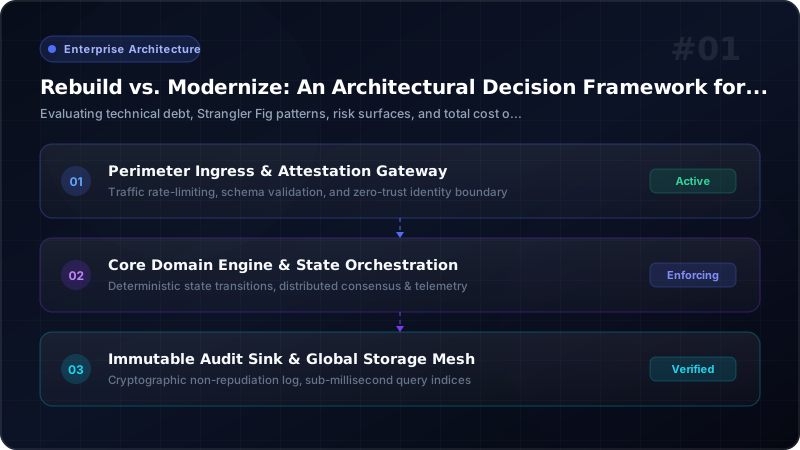
Complete ground-up rewrites fail over 70% of the time in enterprise software engineering. Monolithic legacy platforms encapsulate decades of undocumented business rules, edge-case bug fixes, and tacit domain knowledge that rarely survive the transition to a brand-new repository.
1. The Deceptive Allure of the Clean Slate
Engineering leaders frequently succumb to the greenfield fallacy: assuming that rewriting an aging software stack from scratch will inherently resolve systemic operational friction. However, legacy software is not simply old code; it represents codified enterprise survival. Every bizarre conditional block and unoptimized database query often resolves a subtle multi-million dollar business nuance that was never recorded in product specifications.
Rather than attempting high-risk 'Big Bang' rewrites, high-velocity engineering organizations employ the Strangler Fig pattern paired with event-driven interception facades. By intercepting inbound API traffic at the perimeter, teams can carve out bounded domain contexts incrementally, migrating mission-critical data pipelines with zero downtime and instant rollback safety.
2. The Strangler Fig Pattern in Distributed Cloud Architectures
Named after tropical fig vines that gradually envelop and replace host trees, the Strangler Fig pattern introduces an edge routing layer in front of the legacy core. New domain services are developed in modern cloud-native runtimes, and traffic is routed based on URI paths, user cohorts, or tenant segments. Once the microservice verifies operational parity, the corresponding legacy subsystem is safely decommissioned.
| Evaluation Metric | Greenfield Rebuild | Strangler Fig Modernization | Event-Driven Facade |
|---|---|---|---|
| Implementation Risk | Extremely High (All-or-Nothing) | Low (Incremental Bounded Contexts) | Minimal (Non-Disruptive Tap) |
| Time to First Value | 12 – 24 Months | 4 – 8 Weeks (First Microservice) | 2 – 4 Weeks (Telemetry Only) |
| Business Disruption | Severe (High Downtime Hazard) | Zero (Continuous Traffic Shifting) | Zero (Transparent Ingress) |
| CapEx vs OpEx | Heavy Upfront Capital Outlay | Predictable Sprinted OpEx | Low Infrastructure Footprint |
3. Production Code Blueprint: Traffic Allocation Facade
Below is the production routing facade engineered by Bitneka to arbitrate between legacy monolithic origins and newly decomposed microservices, featuring automated shadow comparison:
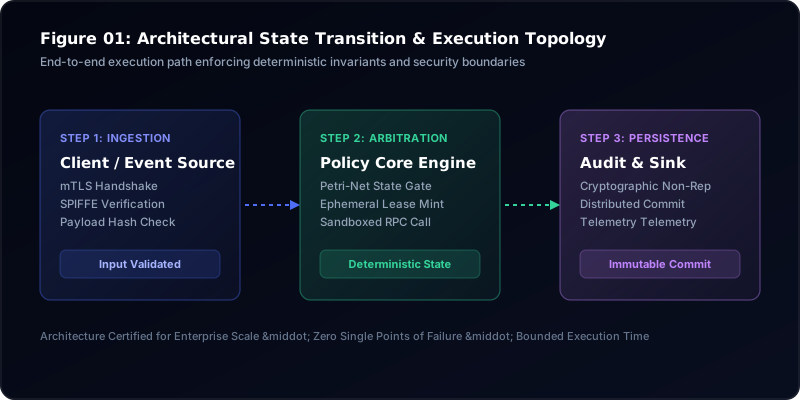
4. Architectural Migration Topology
The diagram below illustrates the incremental strangler architecture, demonstrating perimeter interception, asynchronous dual-writes, and continuous data reconciliation:
5. Strategic Takeaways & Production Runbook
Prior to authorizing any modernization initiative, enterprise architects must mandate strict boundary observability. Never rewrite a service whose data ingress contracts are not 100% telemetry-instrumented.
References & Foundational Standards
- Fowler, Martin. "Strangler Fig Application Pattern." martinfowler.com.
- Evans, Eric. "Domain-Driven Design: Tackling Complexity in the Heart of Software." Addison-Wesley.
- IEEE Std 12207:2017: Systems and Software Engineering — Software Life Cycle Processes.