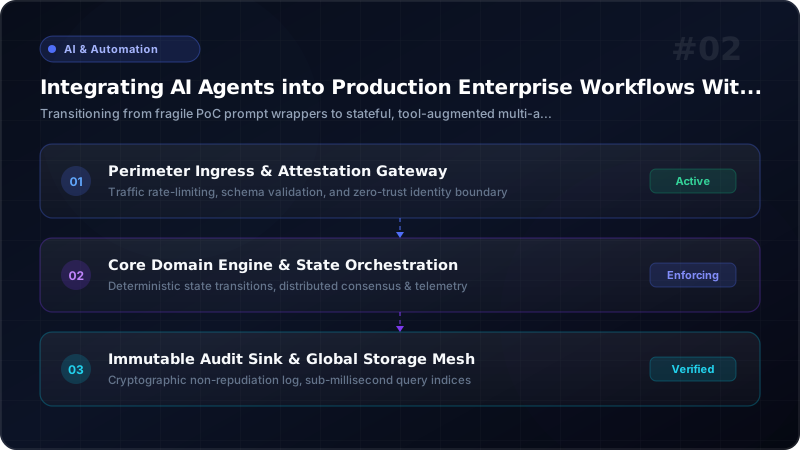
Moving from experimental generative AI chatbots to autonomous enterprise agents capable of modifying production state requires abandoning probabilistic execution assumptions. Foundation models excel at semantic synthesis, but unconstrained tool invocation frequently leads to state corruption, unbounded execution loops, and catastrophic privilege escalation.
1. Beyond the Chatbot: The Era of Agentic Tool Calling
While standard retrieval-augmented generation (RAG) delivers passive question-answering, autonomous agents are characterized by their ability to select tools, observe environment responses, synthesize intermediate conclusions, and execute downstream mutations across enterprise software systems.
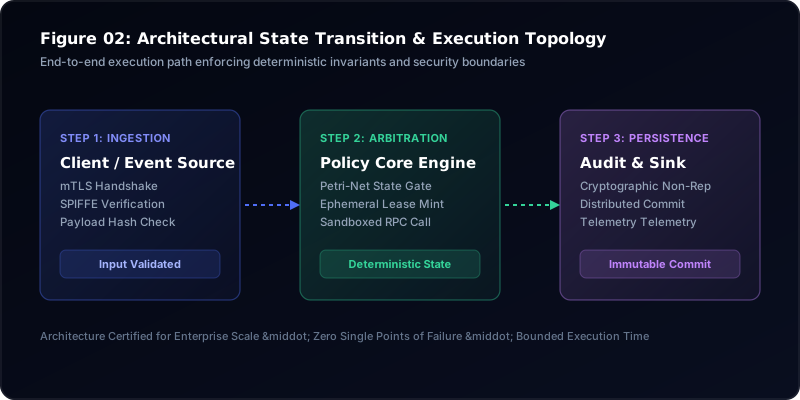
At Bitneka, we implement a three-tier deterministic perimeter around multi-agent clusters: strict JSON-Schema input validation, ephemeral capability-based token issuance, and state machine transitions bounded by formal verification. This ensures that every tool execution carries cryptographic non-repudiation.
2. Sandboxing Agent Capabilities & The Ephemeral Token Perimeter
An autonomous agent must never operate under elevated global database credentials or blanket API keys. Every action requested by an LLM planner is evaluated by a deterministic middleware policy engine. Upon validation, an ephemeral OAuth token with a sub-30-second TTL is minted solely for that specific function signature.
| Paradigm | Direct LLM Invocation | ReAct Prompt Loop | State-Bounded Deterministic Agent |
|---|---|---|---|
| Execution Safety | Uncontrolled / Hallucination Risk | Heuristic / High Drift | Deterministic / Guardrail Enforced |
| State Mutation | Arbitrary / High Vulnerability | Unvalidated Parameters | Idempotent Typed RPC Contracts |
| Auditability | Ephemeral Text Logs | Unstructured CoT Reasoning | Cryptographic Non-Repudiation Log |
| Production SLA | Unpredictable Latency & Costs | Susceptible to Endless Loops | Bounded State Machine TTL |
3. Production Implementation: Typed Tool Dispatcher
The TypeScript implementation below demonstrates how Bitneka enforces strict parameter parsing, token scoping, and non-repudiation audit logging before allowing any model-directed tool mutation:
4. Multi-Agent Coordination Topology
This architectural topology visualizes the supervisory planning model, tool sandbox isolation, and validation firewall protecting downstream enterprise databases:
5. Enterprise Deployment Runbook
Implement structured circuit breakers on all LLM API spending and token consumption. Every autonomous agent loop must enforce hard iteration ceilings to protect production infrastructure.
References & Foundational Standards
- Yao, S. et al. "ReAct: Synergizing Reasoning and Acting in Language Models." ICLR 2023.
- Wu, Q. et al. "AutoGen: Enabling Next-Gen LLM Applications via Multi-Agent Conversation." Microsoft Research.
- ISO/IEC 42001:2023: Artificial Intelligence Management Systems.