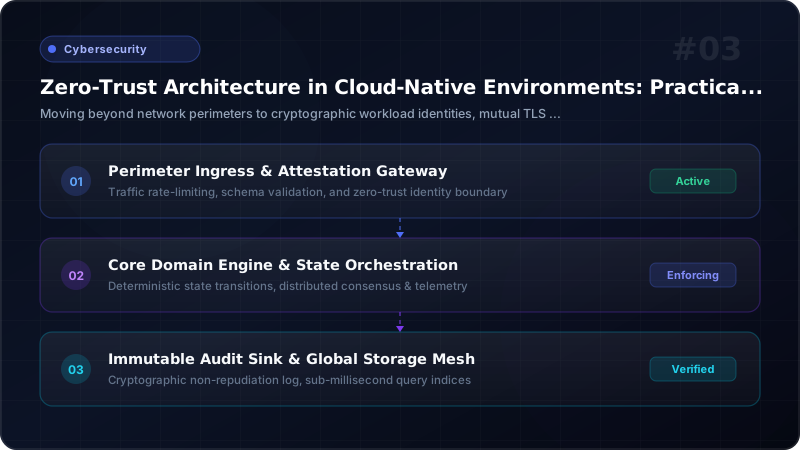
Perimeter network security is fundamentally obsolete in distributed multi-cloud architectures. Once an adversary penetrates a traditional corporate VPN or public-facing ingress proxy, flat internal networks allow unimpeded lateral movement across microservices and databases.
1. The Demise of the Castle-and-Moat Model
In a cloud-native ecosystem spanning Kubernetes clusters, third-party SaaS APIs, and remote engineering teams, the concept of a trusted corporate network is a dangerous fiction. Zero-Trust requires treating every packet—even those between adjacent containers on the same physical host—as potentially hostile.
Modern zero-trust architecture enforces continuous verification: assume breach, verify explicitly, and grant least-privilege access based on cryptographic workload identities (SPIFFE/SPIRE), mutual TLS encryption, and ephemeral hardware-rooted certificates.
2. Workload Identity Attestation via SPIFFE/SPIRE
Rather than relying on fragile IP addresses or static credentials, SPIFFE (Secure Production Identity Framework for Everyone) issues verifiable cryptographic identities to workloads based on kernel-level attestation. Workloads receive short-lived X.509 SVID certificates that rotate automatically every 60 minutes.
| Security Dimension | Perimeter VPN Defense | Network Microsegmentation | Cryptographic Zero-Trust Mesh |
|---|---|---|---|
| Trust Boundary | Network Edge / IP Range | Subnet / Security Groups | Workload Cryptographic Identity (SPIFFE) |
| Encryption in Transit | Edge Only (Plaintext Internal) | Optional Inter-VPC | Strict End-to-End Mutual TLS (100%) |
| Credential Lifespan | Static (Months/Years) | Rotated (Days/Weeks) | Ephemeral Hardware Leases (< 1 Hour) |
| Lateral Movement Risk | Extreme (Flat Intranet) | Moderate (Subnet Traversal) | Near Zero (Deny-All Default Policy) |
3. Production Envoy mTLS and RBAC Configuration
The following Kubernetes manifest demonstrates the deployment of strict mTLS peer authentication paired with fine-grained principal authorization rules:
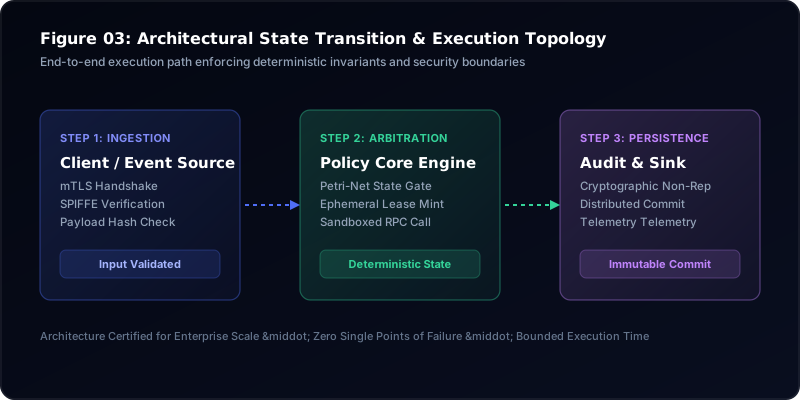
4. Zero-Trust Cryptographic Handshake Pipeline
Below is the architectural flow illustrating node attestation, SPIFFE SVID minting, and continuous cryptographic mutual handshake between microservices:
5. Production Security Implementation Checklist
Transitioning to Zero-Trust requires methodical execution. Begin by deploying mTLS in permissive mode to capture telemetry before shifting to strict enforcement.
References & Foundational Standards
- NIST Special Publication 800-207: Zero Trust Architecture.
- CNCF Security Technical Advisory Group. "Cloud Native Security Whitepaper."
- CISA. "Zero Trust Maturity Model Version 2.0."