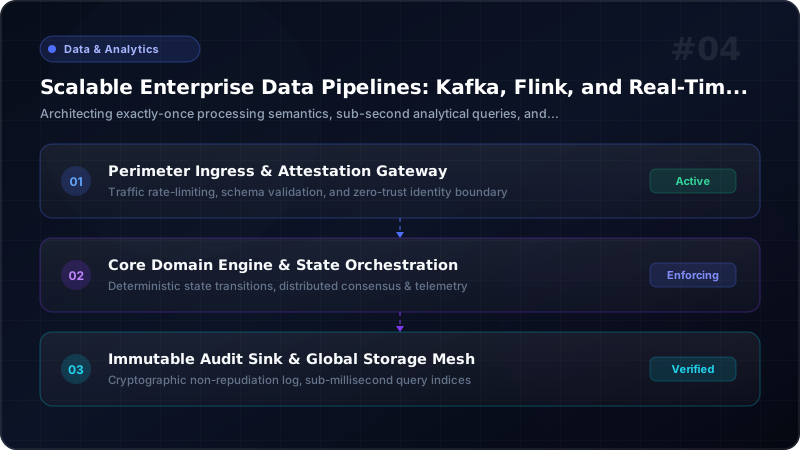
Traditional batch ETL architectures executing overnight cron jobs are incapable of supporting modern real-time enterprise operations. Whether detecting institutional credit card fraud or optimizing global logistics routes, waiting 24 hours for data warehouse updates results in stale insights and lost revenue.
1. The Inadequacy of Nightly Batch Processing
In competitive financial, e-commerce, and logistics markets, operational decisions must occur within seconds of event creation. Batch pipelines introduce unavoidable latency, massive peak computing bills, and cascading pipeline failures when midnight data reconciliation runs stall.
By unifying event-driven log ingestion via Apache Kafka with stateful stream processing in Apache Flink and analytical storage in Apache Iceberg and ClickHouse, organizations achieve sub-second analytical queries on datasets exceeding tens of billions of rows.
2. Stateful Stream Processing with Apache Flink & RocksDB
Unlike stateless event consumers, Apache Flink maintains embedded key-value state backed by RocksDB on local NVMe storage. By utilizing Chandy-Lamport distributed checkpointing, Flink guarantees exactly-once processing semantics even across sudden worker crashes.
| Architecture | Nightly Batch ETL (Spark/Hive) | Micro-Batch Ingestion | Stateful Event Streaming (Kafka + Flink) |
|---|---|---|---|
| Processing Latency | Hours (24h Stale Window) | Minutes (5 – 15 min) | Sub-Second (10 – 50 ms) |
| State Handling | Stateless Job Execution | Micro-State Partitions | RocksDB Local Keyed Stateful Windows |
| Exactly-Once Semantics | Re-run Entire Batch | Idempotent Writes Only | Distributed Chandy-Lamport Snapshots |
| Hardware Footprint | Spiky Cluster Spindown/up | Constant High Overhead | Smooth Distributed Streaming Topologies |
3. Production Stream Definition & Watermark Calibration
The Flink SQL pipeline below demonstrates real-time financial VWAP (Volume Weighted Average Price) computation with sub-second sliding windows and late-arriving event watermarks:
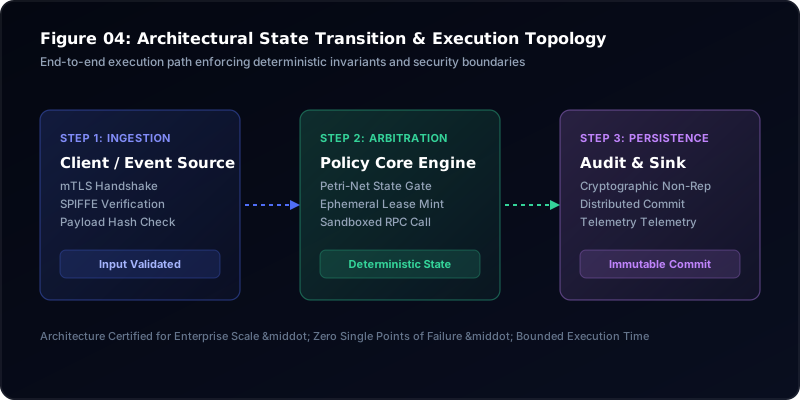
4. Real-Time Streaming Lakehouse Pipeline
This architectural diagram details the end-to-end topology from producer ingestion through Kafka clusters, Flink state engines, and dual-layer analytical sinks:
5. Production Pipeline Checklist
Strict schema governance via Confluent Schema Registry is non-negotiable. Breaking schema changes must fail CI/CD build gates automatically before deployment.
References & Foundational Standards
- Kleppmann, Martin. "Designing Data-Intensive Applications." O'Reilly Media.
- Kreps, Jay, et al. "Kafka: A Distributed Messaging System for Log Processing." ACM NetDB.
- Armbrust, M. et al. "Delta Lake: High-Performance ACID Table Storage over Cloud Object Stores." VLDB 2020.