Every 100 milliseconds of latency costs modern digital businesses up to 1% in conversion revenue. In competitive consumer and enterprise portals, slow Largest Contentful Paint (LCP) and unstable Cumulative Layout Shift (CLS) directly damage organic search rankings and elevate bounce rates.
1. The Economics of Microsecond Web Performance
Consumer patience on digital interfaces has plummeted. Empirical data proves that users begin abandoning multi-step workflows when roundtrip latency exceeds 300 milliseconds. Sub-second performance is no longer a luxury feature; it is foundational revenue architecture.
Achieving sub-500ms global page delivery requires moving computation from centralized origin servers out to edge compute runtimes located within 15 milliseconds of end users. Combining edge-rendered streaming HTML with stale-while-revalidate caching delivers instantaneous perceived load speeds.
2. Modern Edge Runtimes vs. Monolithic Origins
By shifting server rendering from a single AWS or Azure data center to Cloudflare Workers or Vercel Edge networks across 300+ global points of presence, DNS resolution, TLS termination, and DOM rendering occur physically proximate to the client device.
| Architecture Tier | Centralized Origin SSR | Static Site Generation (SSG) | Edge Streaming SSR + SWR |
|---|---|---|---|
| Time to First Byte (TTFB) | 400 – 1200 ms (Cross-Ocean Lag) | 20 – 50 ms (CDN Cached) | 25 – 45 ms (Globally Distributed) |
| Content Dynamism | 100% Real-Time | Stale until Rebuild | Instant Edge Personalization |
| Core Web Vitals (LCP) | Poor to Fair (1.8s – 3.5s) | Good (0.8s – 1.2s) | Elite (< 0.5s Worldwide) |
| Origin Load under Traffic Spikes | Critical Bottleneck Risk | Zero Load on Origin | Protected by SWR Cache Shields |
3. Edge Middleware & Early Hints Implementation
The Next.js edge middleware below configures HTTP 103 Early Hints and aggressive stale-while-revalidate caching headers to eliminate render-blocking roundtrips:
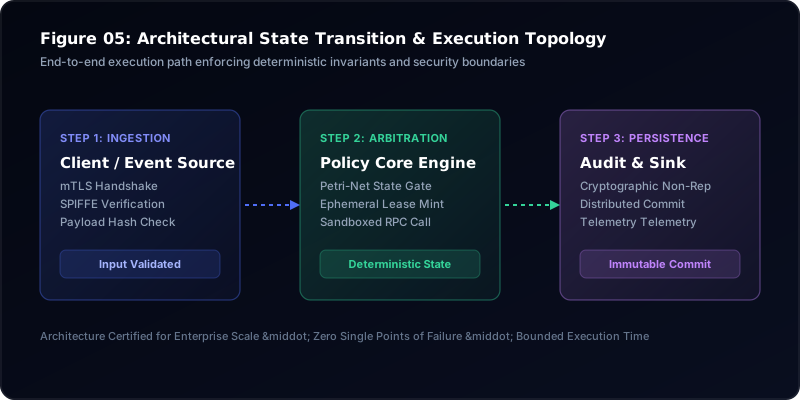
4. Edge Global Acceleration Topology
This diagram illustrates the global Anycast routing, edge cache tiering, and micro-frontend origin decoupling that powers Bitneka client platforms:
5. Production Web Optimization Runbook
Audit all third-party marketing tags and analytics scripts. Never allow untrusted client-side trackers to execute on the critical rendering path.
References & Foundational Standards
- W3C Web Performance Working Group. "Navigation Timing Level 2 & Resource Timing Specifications."
- Google Chrome Team. "Web Vitals: Essential Metrics for a Healthy Site." web.dev.
- RFC 9114: "HTTP/3 Protocol Specification." IETF.