The cross-platform mobile dilemma remains one of the most consequential decisions for engineering leaders. Choosing between React Native's native widget integration and Flutter's bespoke canvas-rendered UI influences architectural flexibility, frame rates, and hiring velocity for years.
1. The Evolution of Cross-Platform Mobile Runtimes
Early cross-platform frameworks suffered from asynchronous JSON bridge bottlenecks that caused dropped frames during rapid list scrolling and complex gesture handling. Today, modern architectures have eliminated serialization overhead entirely.
With React Native's New Architecture (Fabric renderer and Hermes engine with direct C++ JSI bindings) and Flutter's migration to the Impeller GPU rendering backend, both ecosystems have evolved dramatically. Understanding their low-level runtime trade-offs is crucial for enterprise platforms.
2. Fabric & TurboModules vs. Impeller Canvas Architecture
React Native utilizes Fabric to communicate directly with native platform primitives via C++ memory references. Flutter, by contrast, bypasses platform widgets entirely, painting every pixel directly onto a GPU surface via its new Vulkan/Metal-based Impeller engine.
| Technical Dimension | React Native (Fabric & JSI) | Flutter (Impeller Engine) | Native (Swift & Kotlin) |
|---|---|---|---|
| Rendering Model | Native OEM Platform Widgets | Bespoke GPU Canvas (Impeller) | Native OEM Platform Widgets |
| Language & Ecosystem | TypeScript / JavaScript (Massive) | Dart (Focused / Proprietary) | Swift / Kotlin (Separated) |
| Bridge Overhead | Near Zero (Direct C++ JSI) | None (Direct Compiled Native) | None (Direct Native Runtime) |
| Web / Desktop Code Share | High (via React Native Web) | High (Universal Compiled Canvas) | Low (Separate Native Targets) |
3. Direct C++ JSI Invocation Blueprint
The TurboModule specification below demonstrates how React Native applications execute hardware-level biometric encryption routines without serialization latency:
4. Runtime Pipeline & Execution Architecture
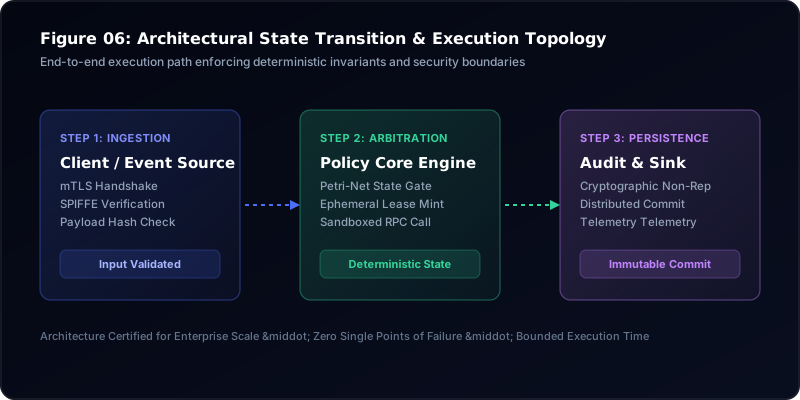
This comparison diagram visualizes how React Native Fabric binds to platform UI trees compared to Flutter's direct hardware rasterization pipeline:
5. Strategic Selection Framework
Select React Native when deep ecosystem integration with web React teams, platform-native look-and-feel, and OTA (Over-The-Air) code updates are prioritized. Choose Flutter when identical pixel-for-pixel rendering across fragmented Android devices and complex custom animations dominate.
References & Foundational Standards
- Flutter Architectural Overview & Impeller Rendering Engine Specification. flutter.dev.
- React Native New Architecture (Fabric & TurboModules) Documentation. reactnative.dev.
- IEEE Software. "Cross-Platform Mobile Development: An Evaluation of Framework Performance."