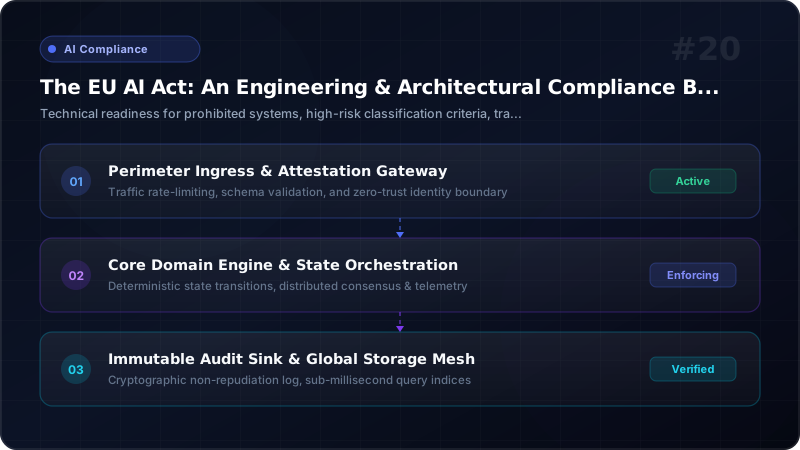
The European Union Artificial Intelligence Act represents the world's first comprehensive horizontal regulatory framework governing the development, deployment, and operation of AI systems. Non-compliance carries devastating penalties: up to €35 million or 7% of global annual turnover.
1. The Risk-Based Architecture of the EU AI Act
The EU AI Act classifies artificial intelligence systems into four distinct tiers based on potential harm to health, safety, and fundamental rights. Systems utilized in recruitment, critical infrastructure, credit scoring, and law enforcement are explicitly designated as High-Risk.
For software architects and engineering leaders, compliance cannot be treated as a post-hoc legal exercise. It requires baking technical conformity directly into application architectures: risk classification gates, cryptographic audit trails, training dataset provenance, and explicit human-in-the-loop oversight mechanisms.
2. Mandatory Technical Conformity Requirements for High-Risk Systems
High-risk systems require continuous risk management systems, documented training dataset provenance with bias testing, automatic logging of operations to ensure traceability, and technical interfaces that enable effective human-in-the-loop oversight.
| Risk Category | Regulatory Obligation | Architectural Requirement / Enforcement |
|---|---|---|
| Unacceptable Risk (Prohibited) | Total Ban (Cognitive Behavioral Manipulation, Social Scoring) | Hard Architectural Block in CI/CD Policy Engine |
| High-Risk Systems (Annex III) | Conformity Assessment, Continuous Logging, Human Oversight | Tamper-Evident WORM Audit Trails & Human Review Gate |
| Specific Transparency Risk | Mandatory Disclosure (AI Watermarking, Chatbot Notice) | Automated C2PA Cryptographic Watermarking |
| Minimal / General Purpose | Voluntary Code of Conduct & Copyright Compliance | Basic Data Governance & Evaluation Telemetry |
3. Production Compliance Logging Implementation
The TypeScript audit logging implementation below demonstrates recording cryptographic hashes of prompts, model identifiers, and human oversight flags onto immutable storage:
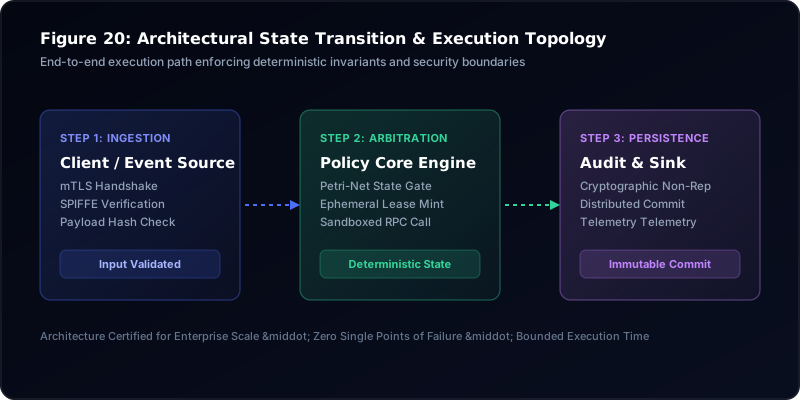
4. EU AI Act Architectural Compliance Gate
This diagram illustrates the regulatory classification gate, automated compliance telemetry logging, and human-in-the-loop escalation pipeline:
5. Engineering Readiness Runbook
Establish an exhaustive enterprise AI asset inventory cataloging all internal foundation models, third-party vendor APIs, and active automated decision pipelines.
References & Foundational Standards
- European Parliament & Council. "Regulation (EU) 2024/1689: Harmonised Rules on Artificial Intelligence (EU AI Act)." Official Journal of the EU.
- NIST. "Artificial Intelligence Risk Management Framework (AI RMF 1.0)." US Department of Commerce.
- ISO/IEC 42001:2023: "Information Technology — Artificial Intelligence — Management System."