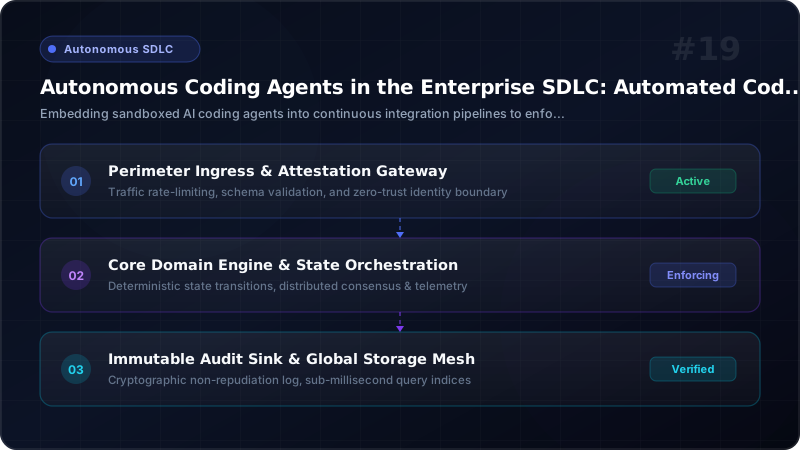
The standard developer experience is transforming from line-by-line code authoring to system-level specification, oversight, and verification. While first-generation code assistants focused on simple inline tab-autocomplete, next-generation autonomous coding agents operate in the background of your software development lifecycle.
1. The Evolution from Autocomplete to Autonomous CI Agents
Tab-autocomplete accelerates typing speed, but typing code is rarely the bottleneck in enterprise software engineering. The true bottlenecks are architecture reviews, debugging regressions, and maintaining test parity across sprawling microservice codebases.
By embedding autonomous agents directly into GitHub/GitLab CI pipelines, organizations automate tedious architectural chores: migrating deprecated framework APIs, enforcing strict architectural layering, synthesizing integration test suites, and auto-patching discovered CVE vulnerabilities.
2. Sandboxed Test-Driven Autonomous Refactoring
An autonomous coding agent operates in an isolated Docker container with access to linters, compilers, and test suites. When presented with a task, it generates candidate code, runs the test suite, parses compiler errors, and iterates autonomously until all checks pass.
| Assistance Paradigm | Inline Autocomplete (Copilot v1) | Interactive Chat Assistant | Autonomous SDLC Pipeline Agent |
|---|---|---|---|
| Interaction Model | Synchronous / Interruptive | Conversational in IDE | Asynchronous / Background CI Triggered |
| Scope of Awareness | Single File / Active Line | Multi-File Active Context | Entire Monorepo AST & Git History |
| Verification Capability | None (Human must debug) | None (Human must execute) | Executes Test Suites in Sandboxes |
| Output Format | Code Snippets | Markdown Explanations | Signed Pull Requests with Green Tests |
3. GitHub Actions CI Pipeline Integration Blueprint
The GitHub Actions workflow below illustrates triggering an autonomous coding agent on pull request creation to perform AST security audits and auto-generate tests:
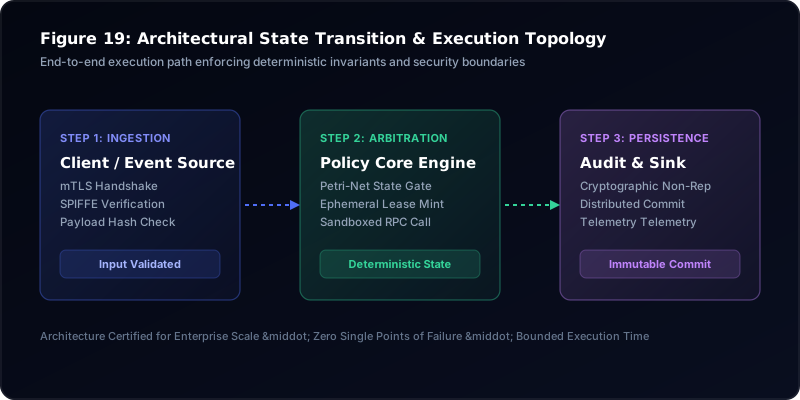
4. Autonomous Coding Agent SDLC Loop
This diagram details the continuous loop of code analysis, sandbox compilation, automated unit test generation, and pull request verification:
5. Coding Agent Governance Runbook
Mandate that all pull requests generated by autonomous coding agents require explicit human senior engineer cryptographic approval before merging.
References & Foundational Standards
- Jimenez, Carlos E. et al. "SWE-bench: Can Language Models Resolve Real-World GitHub Issues?" ICLR 2024.
- Vaswani, Ashish et al. "Attention Is All You Need." NeurIPS 2017.
- GitHub Engineering. "Architecting Copilot Workspace: Human-in-the-Loop Software Generation."