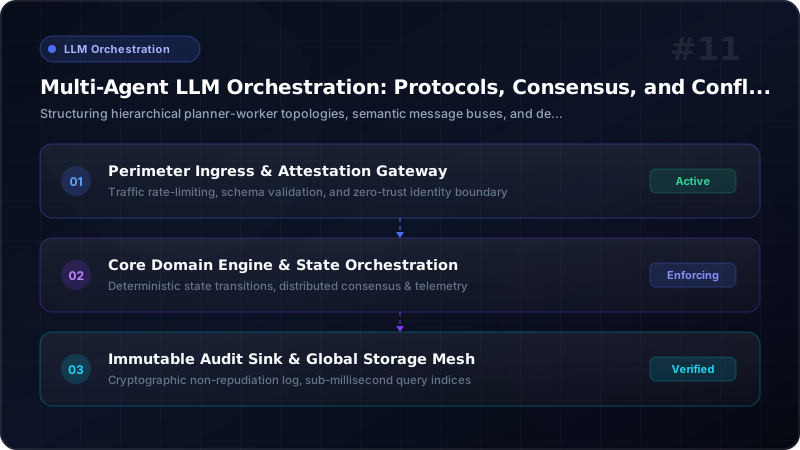
Single-agent LLM systems degrade rapidly when tasked with multi-stage enterprise problem solving. When context windows fill with rambling intermediate deductions, attention mechanisms lose track of original instructions and hallucination rates surge exponentially.
1. Decomposing Monolithic Prompts into Agentic Topologies
Complex business problems cannot be resolved in a single prompt. Forcing a foundation model to simultaneously act as an accountant, software engineer, and compliance officer results in mediocre performance across all three domains.
Multi-agent orchestration decomposes complex workflows across specialized, role-bounded models: a supervisor breaks goals into discrete sub-tasks, specialist workers execute localized investigations, and a critic validates consistency before state transitions occur.
2. Hierarchical Supervisor vs. Peer Consensus
In a hierarchical topology, a supervisory agent acts as an orchestrator, dispatching tasks to worker agents via structured JSON contracts. In a peer consensus model, multiple sub-agents deliberate asynchronously and reach consensus via formal voting protocols.
| Orchestration Topology | Single Monolithic Agent | Sequential Chain (Chaining) | Hierarchical Multi-Agent Mesh |
|---|---|---|---|
| Context Window Bloat | Extremely High (Prompt Clutter) | Moderate (Compounding Errors) | Minimal (Clean Isolated Contexts) |
| Task Specialization | Generic / Shallow | Narrow Step-by-Step | Deep Domain-Specific Prompts & Tools |
| Error Recovery | Fails Catastrophically | Halts at First Broken Step | Dynamic Re-planning & Self-Correction |
| Execution Cost / Latency | Unpredictable Runaway Costs | Linear Cumulative Latency | Parallelized Sub-Agent Execution |
3. Production Consensus Arbiter Blueprint
The Python consensus engine below demonstrates evaluating agent proposals, detecting conflicting outputs, and applying deterministic resolution policies:
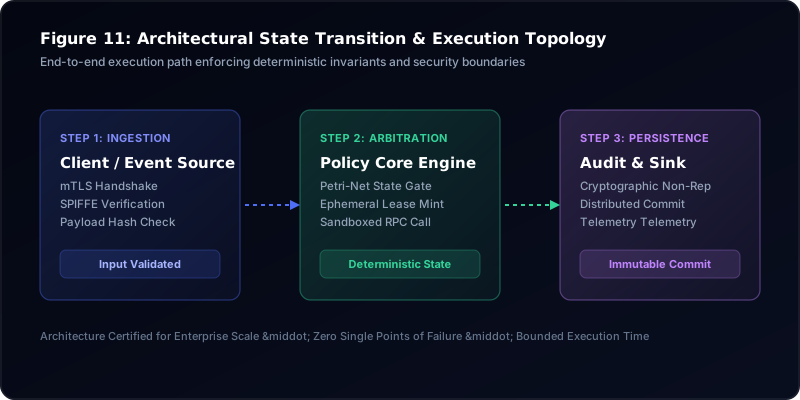
4. Multi-Agent Orchestration & Consensus Flow
This architectural diagram illustrates task decomposition, parallelized worker execution, and supervisory critic arbitration:
5. Production Multi-Agent Runbook
Always implement strict communication timeouts and circuit breakers on inter-agent messaging buses to prevent unbounded deliberation loops.
References & Foundational Standards
- Park, J. S. et al. "Generative Agents: Interactive Simulacra of Human Behavior." ACM UIST 2023.
- Wang, G. et al. "Voyager: An Open-Ended Embodied Agent with Large Language Models." arXiv:2305.16291.
- OpenAI. "Practices for Governing Agentic AI Systems."