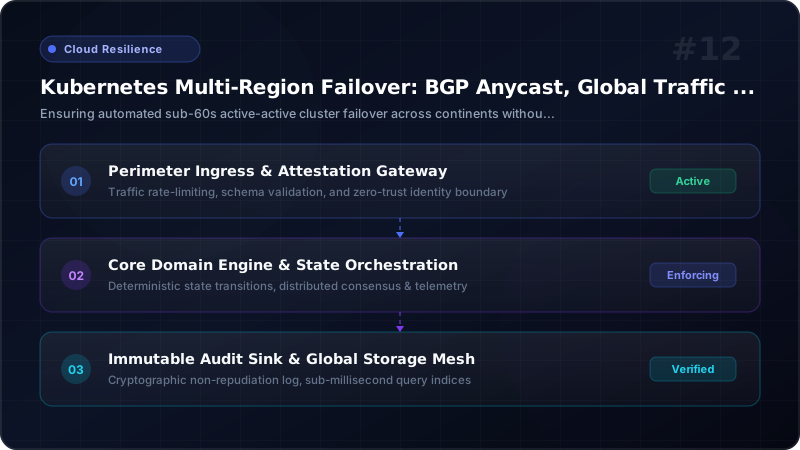
Relying on a single cloud availability zone or geographic region leaves enterprise platforms vulnerable to fiber cuts, power outages, and widespread cloud provider control-plane failures that cause hours of catastrophic downtime.
1. Anatomy of a Cloud Provider Regional Outage
When a major cloud provider experiences an outage in us-east-1 or eu-central-1, internal DNS resolution, IAM token minting, and object storage control planes degrade simultaneously, rendering traditional intra-region failovers useless.
Architecting an active-active multi-region Kubernetes platform requires solving three fundamental distributed systems challenges: global Anycast edge traffic steering, synchronous vs. asynchronous database replication quorums, and automated cluster health probing.
2. BGP Anycast Routing vs. DNS Failover
Standard DNS failovers suffer from client-side ISP TTL caching, taking up to 30 minutes to propagate. BGP Anycast routes traffic to the nearest healthy cluster at the IP routing tier, executing traffic shifts in seconds when edge health checks fail.
| Resilience Strategy | Single Region / Multi-AZ | Active-Passive Pilot Light | Active-Active Multi-Region |
|---|---|---|---|
| Recovery Time (RTO) | 2 – 6 Hours during Regional Outage | 15 – 45 Minutes | Sub-60 Seconds (Automated Anycast) |
| Recovery Point (RPO) | High Potential Data Loss | Low (Async Replication Lag) | Zero (Distributed Consensus DB) |
| Infrastructure Cost | 1.0x Baseline | 1.4x Baseline | 2.1x Baseline (Continuous Double Compute) |
| Split-Brain Risk | None | Low | Critical Challenge (Requires Raft Quorum) |
3. Multi-Cluster Ingress & Service Topology Manifest
The GKE MultiClusterIngress manifest below details automated edge load balancing across geographically separated clusters in North America and Europe:
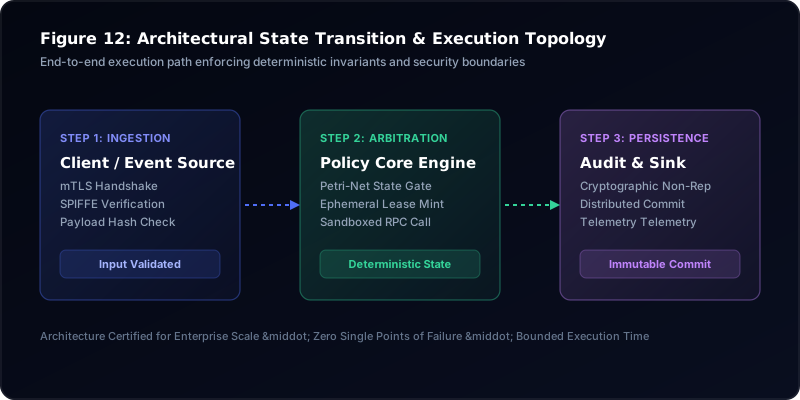
4. Active-Active Multi-Region Failover Architecture
This diagram illustrates Anycast edge ingress steering, inter-cluster service mesh synchronization, and distributed database consensus quorums:
5. Multi-Region Disaster Recovery Runbook
Execute regular automated chaos engineering drills (Chaos Mesh) to verify that simulated regional isolation triggers smooth Anycast rerouting without operator intervention.
References & Foundational Standards
- Burns, Brendan et al. "Borg, Omega, and Kubernetes: Lessons Learned from Three Container Management Systems." ACM Queue.
- RFC 4786: "Operation of Anycast Services." IETF.
- CNCF Operator Whitepaper: "Best Practices for Stateful Cloud-Native Workloads."