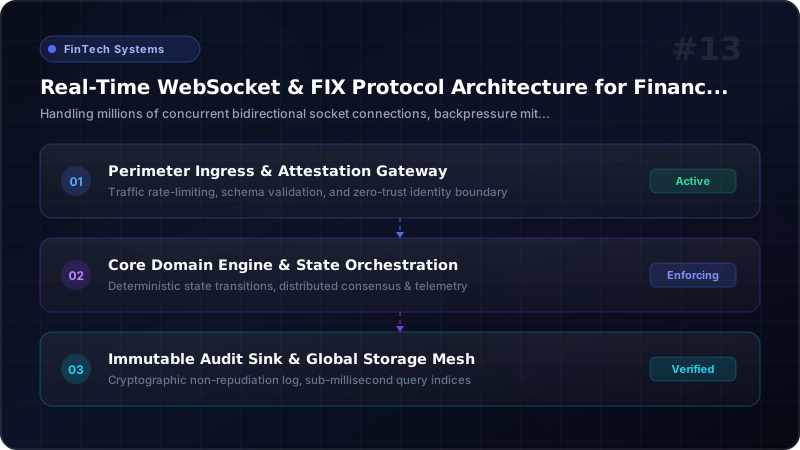
Financial market interfaces and trading platforms operate under brutal performance constraints: order tickets must execute in sub-millisecond windows, and market data feeds must distribute hundreds of thousands of price updates per second without thread starvation.
1. The Anatomy of Financial Market Latency
In institutional capital markets, delayed price quotes result in slippage, unhedged inventory risk, and direct financial loss. Standard web HTTP architectures are fundamentally unsuitable for live trading venues.
Bridging enterprise institutional protocols like FIX 4.4/5.0 with modern web client WebSockets requires zero-copy binary message parsing, lock-free ring buffers, and epoll-based socket multiplexing that bypasses OS context switching bottlenecks.
2. FIX Protocol (Financial Information eXchange) Overview
FIX is the universal language of institutional global trading. Encoded as tag-value pairs separated by SOH (Start of Header) bytes, FIX messages demand zero-allocation parsers to eliminate garbage collection pauses.
| Protocol / Model | HTTP REST Polling | Standard WebSockets (JSON) | Binary WebSocket / FIX Engine |
|---|---|---|---|
| Transmission Overhead | Massive (Headers on every request) | Moderate (Stringified JSON) | Ultra-Low (Packed Binary Bytes) |
| Order Execution Latency | 100 – 500 ms | 15 – 45 ms | Sub-15 Milliseconds |
| Connection Scalability | Stateless / High Port Exhaustion | 50,000 per Core | 500,000+ per Host (uWebSockets/Epoll) |
| Backpressure Protection | Client Polling Throttle | Memory Buffer Explosion | Lock-Free Ring Buffer Dropping/Shedding |
3. Lock-Free Ring Buffer C++ Implementation
The C++ lock-free single-producer single-consumer ring buffer below ensures microsecond order queueing without operating system mutex contention:
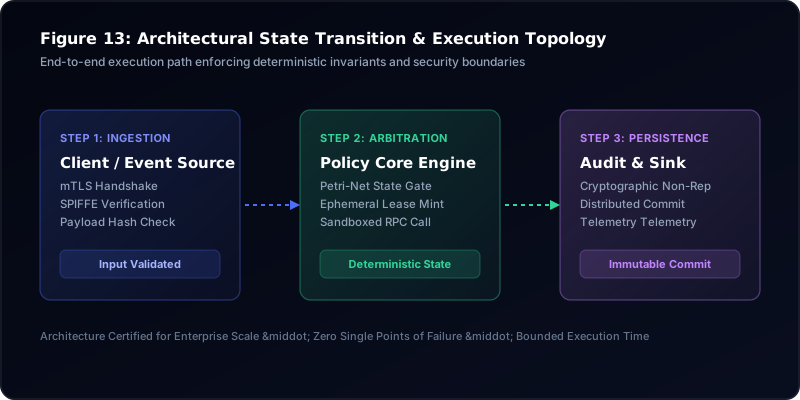
4. FIX Gateway & WebSocket Fanout Architecture
This diagram details the ingress pipeline from institutional liquidity providers via FIX, through zero-copy ring buffers, to client WebSocket terminals:
5. Production Socket Engineering Runbook
Tune Linux kernel TCP parameters (`SO_REUSEPORT`, `TCP_NODELAY`, and `sysctl net.core.somaxconn = 65535`) to eliminate latency spikes during volatile trading events.
References & Foundational Standards
- FIX Trading Community. "Financial Information eXchange (FIX) Protocol Specification v5.0 SP2."
- RFC 6455: "The WebSocket Protocol." IETF.
- Thompson, Martin. "Mechanical Sympathy: Hardware and Software Working Together."