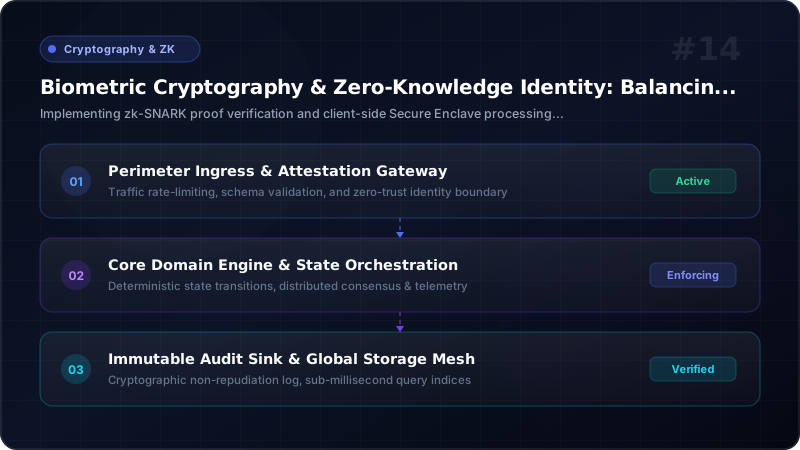
Storing raw biometric identifiers—such as facial vector meshes or fingerprint minutiae templates—in centralized enterprise databases is an immense security liability. If stolen in a database breach, biometrics cannot be rotated like passwords or API keys.
1. The Catastrophic Hazard of Centralized Biometrics
Unlike credit card numbers or passwords, humans only get one face and ten fingerprints. Once a centralized biometric store is compromised by an adversary, affected users face lifetime identity vulnerabilities that cannot be re-issued.
By pairing client-side Secure Enclave biometric attestation with Zero-Knowledge Proofs (zk-SNARKs), enterprises can verify claims—such as identity validity, KYC accreditation, or age thresholds—without the enterprise server ever viewing, transmitting, or storing raw personal data.
2. The Mathematical Foundation of Zero-Knowledge Proofs
Zero-knowledge cryptography allows a Prover to mathematically demonstrate to a Verifier that a specific statement is true, without conveying any information beyond the statement's validity. An enterprise can verify that an employee holds valid admin authorization without recording who they are.
| Security Architecture | Centralized Biometric Database | FIDO2 / WebAuthn | Zero-Knowledge Biometric Identity |
|---|---|---|---|
| Raw Biometric Storage | Centralized Server DB (High Risk) | Encrypted in Hardware Enclave | Client Hardware Enclave Only |
| Breach Blast Radius | Catastrophic (Irrevocable Identity Loss) | Limited to Local Device | Zero (Nothing Leaked on Server) |
| Selective Disclosure | Impossible (All or Nothing) | Device-Bound Credential Only | Mathematical Proof of Single Claim |
| Regulatory Alignment | Severe GDPR/CCPA Liability | Compliant | Gold Standard Sovereign Privacy |
3. Production Client-Side zk-SNARK Verification
The JavaScript implementation below demonstrates generating a Groth16 zero-knowledge identity proof directly on a client device:
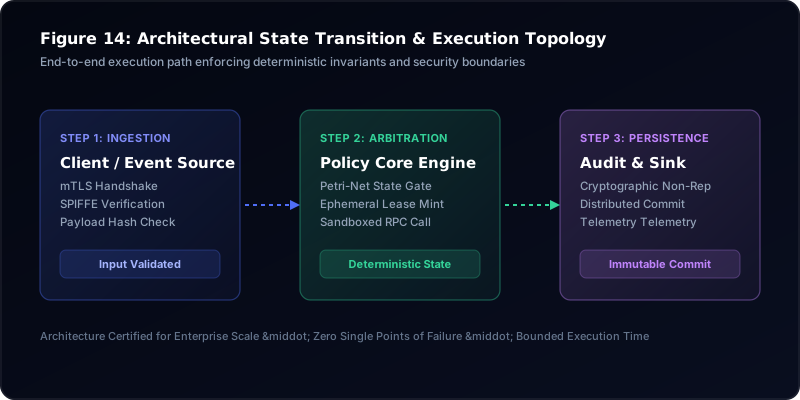
4. Zero-Knowledge Identity Verification Pipeline
This diagram illustrates client-side Secure Enclave processing, mathematical witness generation, and server-side zero-knowledge proof verification:
5. Identity Implementation Runbook
Always leverage hardware-backed Secure Enclaves (Apple Secure Enclave, Android StrongBox) to safeguard private entropy seeds from mobile malware.
References & Foundational Standards
- Goldwasser, S., Micali, S., & Rackoff, C. "The Knowledge Complexity of Interactive Proof Systems." SIAM Journal.
- FIDO Alliance. "FIDO2: Web Authentication (WebAuthn) Level 3 Specification." W3C.
- NIST SP 800-63B: "Digital Identity Guidelines: Authentication and Lifecycle Management."