Streaming high-definition video feeds from hundreds of industrial cameras back to central cloud servers for inference is economically unviable and technically fragile due to bandwidth saturation, satellite latency, and intermittent network outages.
1. The Infeasibility of Cloud-Centric Video Ingestion
A manufacturing facility with 50 4K cameras generates over 1.2 Terabytes of video data every hour. Paying cloud egress fees to stream raw pixels to centralized datacenters creates a severe cost liability and single point of failure.
Executing state-of-the-art computer vision models directly on edge hardware—such as Nvidia Jetson, Raspberry Pi 5, or custom NPU accelerators—requires neural network pruning, INT8 quantization, and hardware-specific compilation that slashes memory footprints by 75% with negligible accuracy loss.
2. Mathematical Foundations of INT8 Quantization
Quantization maps continuous 32-bit floating point weights into discrete 8-bit signed integers using a calibrated scaling factor and zero-point offset. The hardware's tensor cores can execute four INT8 matrix operations in the same cycle time as a single FP32 instruction.
| Model Format | FP32 Unoptimized Cloud Model | FP16 TensorRT Engine | INT8 Post-Training Quantized Engine |
|---|---|---|---|
| Model Size on Disk | 240 MB | 120 MB | 60 MB (75% Reduction) |
| Inference Latency (Edge) | 120 ms (Unusable for 60 FPS) | 32 ms | 8.5 ms (Real-Time 110+ FPS) |
| Thermal / Power Draw | 45 Watts (Requires Active Fan) | 25 Watts | 10 – 15 Watts (Passive Cooling) |
| mAP Accuracy Drop | Baseline (100%) | 99.8% of Baseline | 99.1% of Baseline (Within Tolerance) |
3. TensorRT INT8 Engine Compilation Pipeline
The Python automation script below demonstrates building an INT8-quantized execution engine using Nvidia TensorRT with dynamic calibration:
4. Edge Vision Optimization & Inference Pipeline
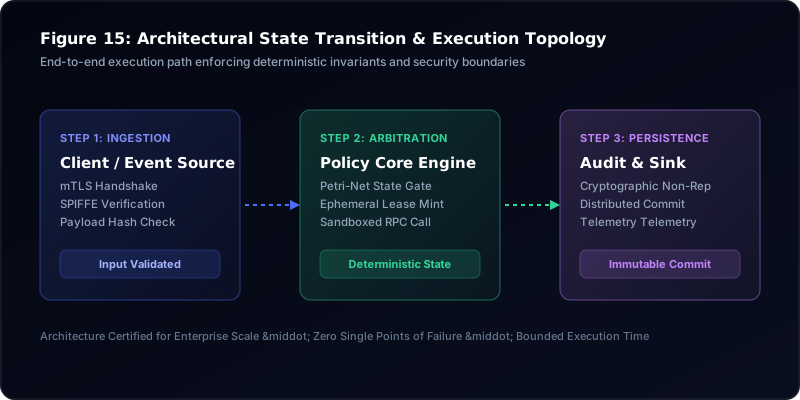
This diagram illustrates the compilation pipeline from PyTorch through ONNX graph optimization, INT8 calibration, and real-time inference on edge NPU silicon:
5. Edge Deployment Runbook
Always assemble a representative calibration dataset containing actual field lighting, weather conditions, and lens distortions to avoid quantization drift.
References & Foundational Standards
- Gholami, A. et al. "A Survey of Quantization Methods for Efficient Neural Network Inference." arXiv:2103.13630.
- Redmon, J. & Farhadi, A. "YOLOv3: An Incremental Improvement." arXiv:1804.02767.
- NVIDIA Developer. "TensorRT High-Performance Deep Learning Inference Whitepaper."