The fundamental paradigm of foundation model scaling has shifted. While early progress was driven by pre-training compute (more parameters, larger token datasets), the frontier of artificial intelligence is now governed by inference-time compute: allowing models to 'think' using hidden reasoning tokens before responding.
1. The Paradigm Shift to Test-Time Compute
Pre-training scaling laws face diminishing returns due to web data exhaustion and power constraints. Inference-time compute circumvents this ceiling by allowing models to generate hidden reasoning traces that explore alternative solution paths before committing to an answer.
OpenAI's o-series architectures demonstrate that allocating additional compute during inference enables models to perform Monte Carlo tree search, self-correction, and formal deductive validation—fundamentally outperforming traditional prompt engineering on complex enterprise logic.
2. Selecting Between Direct Generation and Reasoning Models
Reasoning models should not be used for consumer chatbots or casual summarization; their higher latency and token cost make them ideal for complex planning, multi-step forensic accounting, cryptographic verification, and complex code refactoring.
| Capability Metric | Standard LLMs (GPT-4o) | Reasoning Models (o1 / o3-mini) |
|---|---|---|
| Inference Paradigm | Next-Token Autoregressive Predictor | Test-Time Search & Verification Trees |
| Complex Logic & Math | Prone to Hallucinated Derivations | Near-Perfect Deductive Reasoning |
| Time to First Token (TTFT) | Fast (200 – 600 ms) | Variable (3 – 25 Seconds Thinking Time) |
| Optimal Enterprise Use Case | Creative Copy, Search Summaries, Chat | Code Synthesis, Legal Auditing, Forensics |
3. Production Python Integration with Structured Schemas
The Python implementation below demonstrates querying an OpenAI reasoning model with strict Pydantic output validation and calibrated reasoning effort:
4. Inference-Time Search & Self-Correction Pipeline
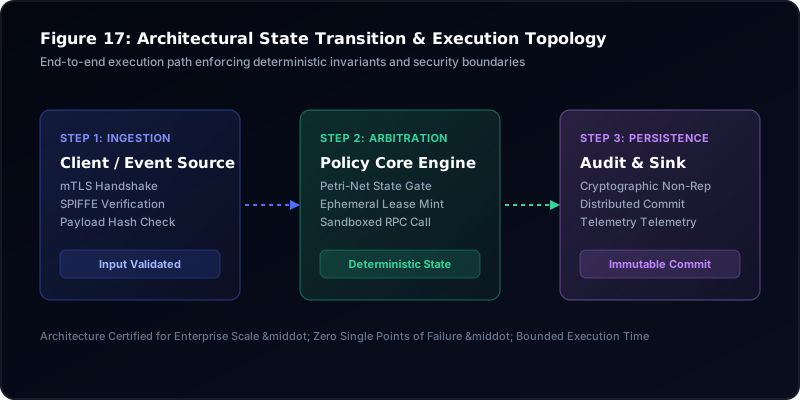
This diagram illustrates how reasoning models evaluate alternative deduction branches, prune unpromising paths, and generate verified answers:
5. Enterprise Integration Runbook
Architect your backend asynchronous task queues with WebSocket streaming to provide users with visible progress indicators during 15-second reasoning phases.
References & Foundational Standards
- OpenAI. "Learning to Reason with LLMs: O-Series Technical Analysis." openai.com.
- Snell, Charlie et al. "Scaling LLM Test-Time Compute Optimally can be More Effective than Scaling Parameters." UC Berkeley / arXiv:2408.03314.
- Lightman, Hunter et al. "Let's Verify Step by Step: Process-Supervised Reward Models." OpenAI.